
Winston-Salem Previous Residents by Era
Different sources preserve different parts of an address history. A deed identifies a recorded transfer and its legal description. A directory places a printed name at a dated address. A map describes the building and street context, while a census or newspaper can add a household or event. The strongest result keeps the source type and date visible, rather than turning one old listing into a claim about present occupancy.
| Source | Years It Covers | Where Held | What It Shows |
|---|---|---|---|
| Forsyth deed books and index | Instruments from 1849; official recording history begins in 1913; computerized indexes from 1965 | Register of Deeds, Forsyth Deeds, and archives | Grantor-grantee chain, legal description, plats, encumbrances, and recording dates |
| Winston-Salem city directories | North Carolina Room 1898 to present; earlier scans from 1879–80 onward | Library, NCGenWeb, DigitalNC, and Wake Forest | Dated resident or business address and occupation context |
| Sanborn maps | 1885, 1890, 1895, 1900, 1907, and 1917–1950 sets | Library of Congress, Forsyth Library, and Wake Forest | Building footprint, use, street, and lot context |
| Federal census | Images follow the 72-year release rule | National Archives and library databases | Household composition and address or place context at the census date |
| Newspapers and archives | Coverage varies by title and collection | Forsyth Library, WSSU, WFU, and DigitalNC | Dated moves, notices, deaths, organizations, and address references |
For a recent transfer, begin with the parcel and deed index. For a question about who lived at a location in an earlier period, begin with the nearest dated directory, then test it against a map, census, newspaper, or archive record. A record that is not online may still be available in a research room or through an archive box list.
Start a Winston-Salem Address Trail
The current parcel record is a practical starting point, not the final answer. The county Tax Property Portal and MapForsyth Tax Parcel Viewer can connect an official address to a parcel number or REID, an assessment snapshot, and links toward deed material. Save the tax year, official address, parcel identifier, and retrieval date before moving to another source.
Tax information can lag a recorded transfer, and a displayed owner or mailing address does not prove who lives at the property. From the parcel identifier, locate the latest recorded deed and compare its book or page reference with the legal description. For a present street-wide record trail, the Winston-Salem streets reference keeps the address-keyed sources separate from this backward house-history method.
Winston-Salem Past Owners in Deed Chains
Forsyth County deeds move the address trail backward through named parties and recording references. The public Forsyth Deeds index shows party name, grantor or grantee role, date, code-book-page, document type, description, reverse party, status, cross-reference, and image links in the inspected result. Read the deed image and legal description before treating an index row as a property transfer.
- Search the current official address or parcel in the tax and GIS tools, then record the REID, parcel number, and tax-year context.
- Use the current owner as a lead in the deed index and identify the deed that matches the parcel’s latest acquisition.
- Copy the recording date, book and page or instrument number, document type, and legal description from the deed image.
- Search the seller named as grantor in that deed as a grantee, which can reveal that party’s earlier purchase of the same parcel.
- Repeat the transaction trail backward, checking both name roles and moving to office, microfilm, or archive sources when the format changes.
- Grantor / grantee
- The grantor transfers or conveys an interest; the grantee receives it. Either role can be a person, estate, trust, lender, or entity.
- Chain of title
- The ordered sequence of recorded transfers and related instruments used to trace a parcel through time.
- Legal description
- The lot, block, plat, subdivision, metes, or other deed language that identifies the land more reliably than an old street number.
Deeds of trust, satisfactions, easements, and rights-of-way can appear beside a deed without changing ownership. Keep the document type beside every result. The Register of Deeds records instruments, but it does not provide legal advice or a certified boundary opinion.
Forsyth Deed Formats Through Time
A long Winston-Salem address history can cross several record formats. Forsyth County reports instruments from 1849, an official-recording history beginning in 1913, handwritten copies from 1849 to 1904, typed copies from 1904 to 1929, microfilming from 1954, and computerized indexes beginning in 1965. That sequence explains why an index result may lead to a manuscript book, a microfilm image, or a later digital image.
| 1849 to 1904 | Handwritten copies may require careful reading of names, descriptions, and page references. |
|---|---|
| 1904 to 1929 | Typed copies form a different physical record layer from the earlier manuscript volumes. |
| From 1954 | Microfilming added another access format, while computerized indexes began in 1965. |
This chronology is also a useful limit on a prior-resident search. An image can be difficult to read, an index can exist without a digital image, and a database result is not proof that every earlier volume has been digitized.
Winston-Salem Past Residents on Sanborn Maps
Historic maps help decide whether an old address still describes the same place. The Library of Congress Winston-Salem Sanborn collection includes sets from 1885, 1890, 1895, 1900, 1907, and 1917 through November 1950. The 1917 to 1950 set has 79 sheets. These maps show buildings, construction, use, streets, and lot context, not a list of residents.
Record the sheet number, date, volume, and page coordinates when a map is used. A changed footprint, street name, or number is a reason to compare the deed’s legal description, plat, historic map, and GIS geometry. The Forsyth Library also lists Digital Sanborn coverage for North Carolina from 1867 to 1970, subject to database access conditions.
Winston-Salem Directory Years and Census
Directories add the household layer that deeds usually cannot provide. The North Carolina Room holds Winston-Salem volumes from 1898 to the present, and scans and catalogs identify earlier editions from 1879–80 onward. DigitalNC is incomplete by year. An alphabetic entry can provide a dated name, address, and occupation or business context, but exact symbols and any address-oriented section must be verified from the particular edition.
- Record the directory’s edition year, printed name, address, and page before comparing it with any other source.
- Search nearby directory years for a move, a spelling variant, or a business cross-reference, recording a no-result year as well.
- Pair the dated address or place reference with the available federal census, which follows the 72-year release rule.
- Use a newspaper notice, deed, map, or institutional collection to test the relationship between the person and the location.
The Winston-Salem city directory collections provide the shelf and repository detail for that part of the trail. A directory entry remains a dated publication statement, not a current address claim or a substitute for a deed.
The Forsyth County Public Library North Carolina Collection provides the local research setting for directory, newspaper, map, and archive work.
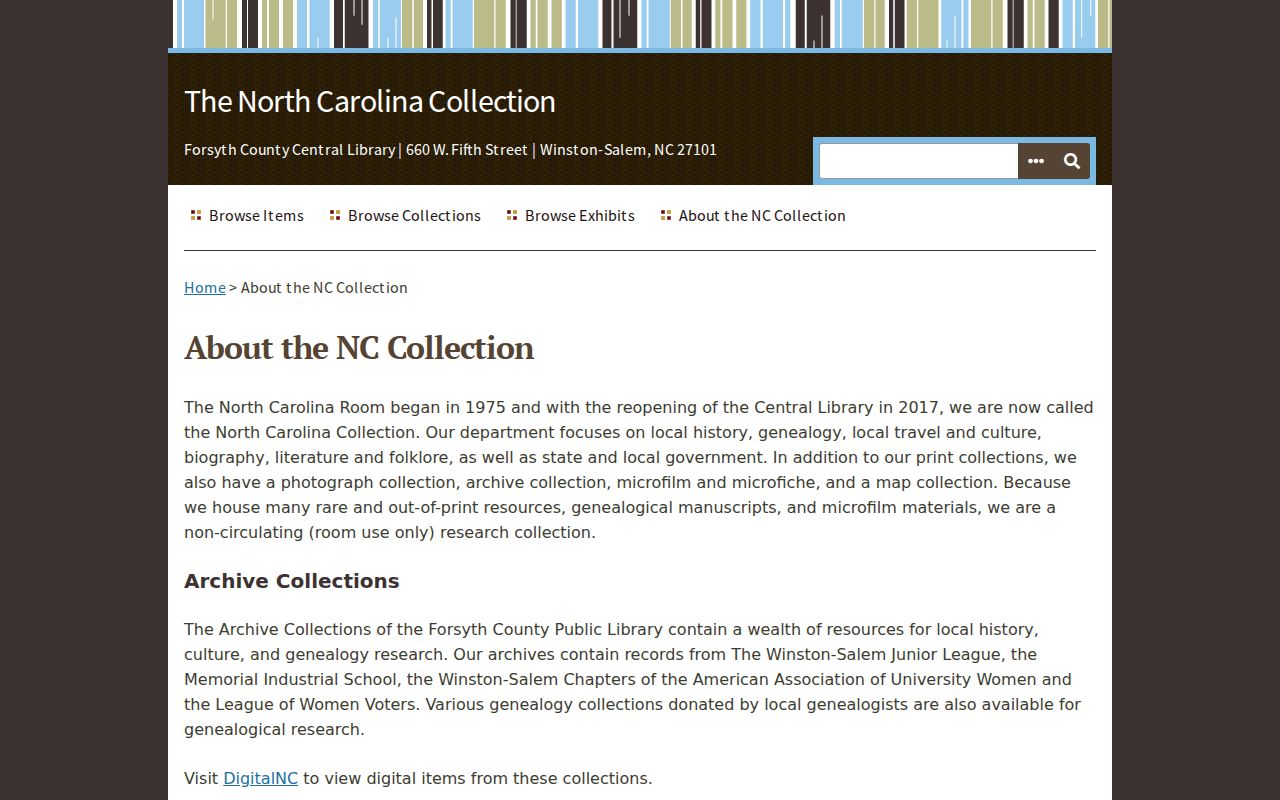
Its non-circulating collections, research computers, microfilm readers, and staff assistance make it a useful place to verify a page, compare a newspaper lead, or request an archival item.
Winston-Salem Archives for Past Residents
A search may need to leave the online index. The North Carolina State Archives’ county-record box lists lead to Forsyth court, land, estate, tax, marriage, vital, and special-proceeding series, but a box-list entry is a finding aid rather than a digitized document. Preserve the repository, record series, date span, box, and any advance-request requirement in the research note.
WSSU archives offer yearbooks, catalogs, photographs, oral histories, News Argus, and TC Informer material for community and institutional context. Wake Forest Special Collections, Old Salem, and the library’s newspaper index offer other routes. For a death or departure clue, pair an obituary or cemetery inquiry with the dated directory and an authorized vital, court, or estate record when access permits.
Salem, Winston, and Older Address Names
Place names can break an otherwise careful search. Salem was established by Moravians, Winston developed as the county-seat city after Forsyth County formed, and the two cities consolidated as Winston-Salem in 1913. Earlier entries can name Salem, Wachovia, Winston, Forsyth County, a township, a rural route, or a post office instead of the modern city.
Search those variants with the surname, street, subdivision, or legal description. If a street number changes, compare the plat lot or block, Sanborn footprint, deed language, and modern GIS shape rather than trusting one address string. The same approach helps distinguish a genuine move from a renamed place or a changed numbering scheme.
Past Households at a Winston-Salem Address
Previous residents and prior owners are not the same category. A deed can establish a transfer trail, while a directory, census, newspaper, yearbook, or obituary can supply a dated household or community reference. City-owned cemetery records cover historical interments, but no stable official name-searchable database was located. A records inquiry is more useful when it includes a full name, approximate date, cemetery if known, and family or lot context.
Obituaries can identify relatives, former addresses, organizations, and funeral arrangements, but they remain secondary publications. Keep the publication date and original notice with the research note, then verify legal names and dates through the proper custodian when that access route is available. This approach preserves the difference between a historical lead and a proven record fact.
Lawful use. Research previous residents for family history, estate work, house history, or personal curiosity, and never use an old address trail to harass, track, or endanger anyone.